Residential furnace replacement · Fort Wayne & Allen County
Furnace Replacement Fort Wayne IN
Residential furnace replacement and new furnace installation for Fort Wayne-area homeowners. Compare replacement options, understand likely costs, and request a free quote 24/7.
For service availability, please have your 5-digit ZIP code ready.
Residential Only
Focus
24/7 Service
Availability
Free
Quote
Fort Wayne & Nearby
Coverage
How Much Does Furnace Replacement Cost in Fort Wayne?
Many 2026 Fort Wayne planning estimates fall roughly in the $4,000–$7,500 range for a straightforward furnace-only replacement, while high-efficiency or complex installations can fall outside that range.
Planning estimate only. Your actual quote depends on the home and installation requirements.
The reason a single price can't be quoted online is that installed cost is set by the home, not by the box. Two houses on the same street can produce quotes hundreds or thousands of dollars apart for entirely legitimate reasons.
A complete quote should name the model and input rating, the efficiency and stage, the warranty terms, and every piece of work required to make that furnace operate safely in your specific mechanical space. If a quote is a single number with no scope, you have nothing to compare.
What actually changes the installed cost
- Home heating load
- Furnace size (BTU input and output)
- AFUE / efficiency level
- Single-stage, two-stage or variable operation
- Venting type and routing
- Gas piping or electrical changes
- Duct and plenum transitions
- Thermostat requirements
- Access difficulty
- Removal of existing equipment
- Permit and inspection requirements
Interactive tool
Fort Wayne Furnace Replacement Cost Calculator
Answer a few questions about your home and the existing system to get a broad planning range, plus the factors most likely to move your number. This is a planning tool, not a quote, and nothing is submitted anywhere.
Your planning range
Answer the questions and select Estimate My Furnace Replacement Cost. You'll get a broad planning range plus the factors most likely to move your number.
Signs It May Be Time to Replace Your Furnace
No single item on this list means replacement is mandatory — including age. What matters is how many of them are true at once, and what an evaluation finds inside the equipment.
It's in the 15+ year range
Most residential furnaces deliver 15–20 years. Reaching that range means planning is reasonable, not that the furnace must be replaced today.
Repeat breakdowns
Two or more significant repairs in a couple of years usually signals broader wear rather than isolated bad luck.
Rising heating usage
If usage climbs while your habits and the weather stay similar, the system may be losing efficiency or struggling to keep up.
Uneven rooms
Rooms that never catch up can indicate sizing or distribution problems a replacement is a good moment to address.
Excessive cycling
Frequent on-off cycling is often a symptom of an oversized furnace or an airflow restriction.
Persistent noises
Rattles, booming ignition and blower noise that returns after repairs point to mechanical wear.
Visible corrosion
Rust at the cabinet, burners or vent connections deserves a close look at combustion and venting.
Heat exchanger concerns
A suspected or confirmed cracked heat exchanger is a safety matter and typically ends the repair conversation.
Parts are hard to source
Discontinued components mean longer outages — a serious problem in a Fort Wayne January.
Repair cost vs remaining life
A large repair on equipment with a few years left rarely makes financial sense compared with replacement.
Interactive tool
Repair or Replace? Decision Tool
This tool organizes your own answers into general guidance. It is not a diagnosis, and it cannot inspect your heat exchanger, venting or combustion — only a hands-on evaluation can.
Your guidance
Answer the six questions to see where your situation generally lands. This tool organizes your own answers — it is not a diagnosis and it does not inspect your equipment.
Want the longer version? Read our repair-or-replace guidance for Fort Wayne homeowners.
Old vs New Furnace: What Actually Changes
The comparison below is illustrative. Real-world results depend on the equipment you choose, how it's sized, and the condition of the home it's installed in.
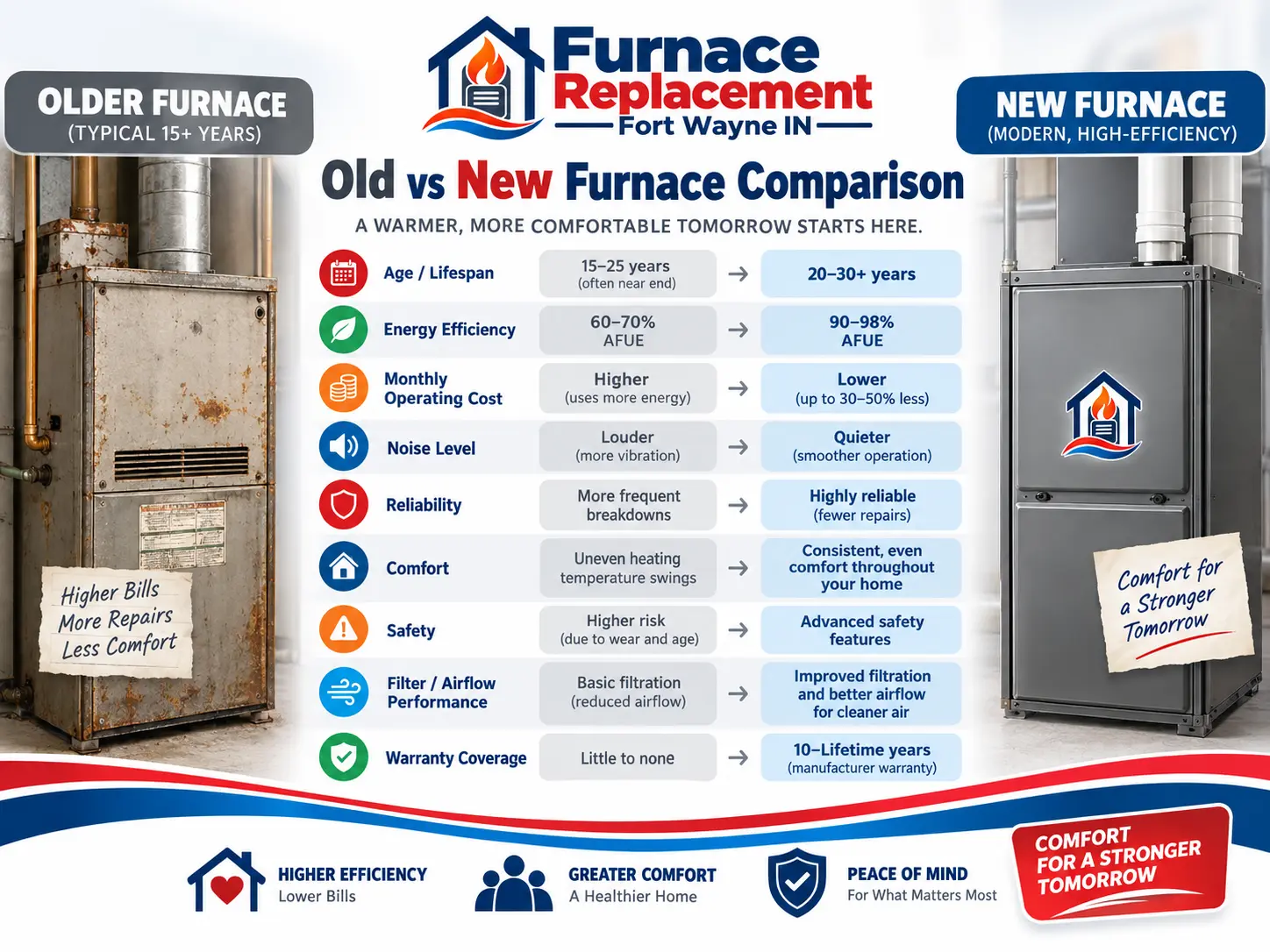
An older furnace (typically 15+ years)
- Lower efficiency, depending on the specific equipment and its age
- More accumulated wear across blower, burners and controls
- Potentially louder operation, especially at startup
- Greater repair uncertainty and parts-availability risk
- Older controls with limited thermostat compatibility
- Frequently sized by rule of thumb rather than a load calculation
A modern replacement
- Higher efficiency options, including condensing equipment
- Multi-stage or variable-speed operation where applicable
- Modern controls and broader thermostat compatibility
- New manufacturer warranty eligibility, subject to registration terms
- Potentially quieter operation, particularly at low stage
- An opportunity to correct sizing for the home as it exists today
We won't tell you a new furnace will cut your bills in half. Fuel savings depend on the efficiency of what you have now, the efficiency of what you install, how the system is sized, and how your home loses heat.
Residential Furnace Replacement Options
Every page below is residential furnace replacement or installation. We don't do commercial HVAC, plumbing, electrical or duct cleaning — this is the whole business.
New Furnace Installation
How a replacement furnace is planned, sized and installed in an existing Fort Wayne home.
Read more →Furnace Replacement Cost
What drives the installed price, line by line, plus how to read a written quote.
Read more →Gas Furnace Replacement
Natural gas and propane replacements, venting, gas line and combustion air basics.
Read more →High-Efficiency Furnace Replacement
Condensing furnaces, AFUE, PVC venting and condensate drainage explained simply.
Read more →Emergency Furnace Replacement
What to do when the heat is out in January and replacement can't wait for spring.
Read more →Mobile / Manufactured Home Furnace Replacement
Why manufactured homes often require specifically approved furnace configurations.
Read more →Repair or Replace?
A structured way to weigh a repair bill against the remaining life of the system.
Read more →How Furnace Replacement Works
Ten steps, in the order they actually happen. Many straightforward replacements can often be completed within a working day, while complications can extend the project.
- Step 1
Initial call
We confirm service availability for your ZIP code and the basics of your situation.
- Step 2
Home evaluation
The existing furnace, venting, ducts, gas supply and electrical are reviewed in person.
- Step 3
Sizing considerations
Heating load drives equipment selection instead of copying the old nameplate.
- Step 4
Equipment options and quote
Efficiency levels, staging, warranty terms and scope of work in writing.
- Step 5
Permit requirements
Where applicable, permitting is addressed before installation begins.
- Step 6
Removal of existing furnace
The old unit is disconnected, taken out and prepared for disposal.
- Step 7
New furnace installation
The replacement is set, leveled, connected and sealed.
- Step 8
Venting, gas, electrical, ducts
Flue or PVC venting, gas connection, electrical and plenum transitions.
- Step 9
Startup and safety checks
Operation, airflow and combustion are verified and documented.
- Step 10
Homeowner walkthrough
Thermostat operation, filter location, and what to watch for going forward.
For service availability, please have your 5-digit ZIP code ready.
Proper Furnace Sizing (Read This Before You Buy)
Sizing is the single most consequential decision in a furnace replacement, and it's the one homeowners are least often shown. An oversized furnace heats fast, shuts off, and leaves the house with temperature swings, extra wear and noisier operation. An undersized furnace never quite recovers on the coldest nights.
BTU input vs BTU output
Input is how much fuel energy the furnace consumes per hour. Output is how much heat actually reaches your home. A 100,000 BTU input furnace at 80% AFUE delivers roughly 80,000 BTU of heat; at 96% AFUE it delivers roughly 96,000. Comparing two quotes on input alone can mean comparing two very different amounts of delivered heat.
Why square footage alone is not enough
Two 1,800 square foot homes in Fort Wayne can have meaningfully different heating loads. A proper calculation accounts for insulation levels in walls and attic, window area and glazing type, air leakage, orientation and exposure, ceiling height, duct system capacity and location, whether the basement is finished, and any additions that were built without the heating system growing to match.
Why copying the old furnace size can be wrong
The existing furnace was often sized by rule of thumb decades ago, then possibly replaced by matching that first guess. Meanwhile the home may have gained insulation, new windows or air sealing. Matching the nameplate simply inherits whatever mistake came before.
Manual J is the established residential load-calculation methodology in the United States, and it's the reference point for doing this properly. We deliberately do not offer a "square feet equals BTUs" widget, because that shortcut is how homes end up with oversized equipment.
Questions worth asking any contractor
- How did you arrive at the BTU input you're proposing?
- Did you account for insulation, windows and air leakage?
- What's the output, not just the input?
- Is the return air adequate for the new blower?
- Will any duct transitions be needed, and are they in the price?
- What happens if the equipment turns out to be oversized?
80% vs High-Efficiency Furnaces
Both are legitimate choices. The right answer depends on your home's venting, how long you plan to stay, and how much of the installation work the upgrade requires.
| Consideration | ~80% AFUE (non-condensing) | 90–98% AFUE (condensing) |
|---|---|---|
| AFUE | Roughly 80% of fuel becomes usable heat | Roughly 90–98% becomes usable heat |
| Venting | Metal flue, often into an existing chimney | PVC intake and exhaust to an approved termination |
| Condensate | None to manage | Produces condensate; needs a drain or pump |
| Upfront cost | Lower equipment and often simpler install | Higher equipment, plus venting conversion in some homes |
| Energy use | More fuel for the same delivered heat | Less fuel for the same delivered heat |
| Comfort features | Commonly single-stage | Frequently available two-stage or modulating |
| Install considerations | Chimney condition and shared-flue appliances matter | Termination location, clearances and drainage matter |
We deliberately avoid promising a specific percentage of savings. What you save depends on the efficiency of your current equipment, your fuel cost, your thermostat habits and your home's heat loss. Read the full 80% vs 96% comparison.
Does Furnace Replacement Require a Permit in Fort Wayne?
Residential furnace replacement generally requires the applicable HVAC/mechanical permit through the Allen County Building Department. Permitting exists to make sure combustion venting, gas connections, clearances and electrical work meet the adopted code — the parts of the job a homeowner cannot easily inspect afterward.
Requirements may vary with the scope of the project, and local rules can change. Confirm the current requirements for your specific job rather than assuming what applied to a neighbor's replacement last year also applies to yours.
If your address is outside Allen County — Roanoke, Columbia City, Auburn, Decatur, Churubusco or Ossian, for example — permitting is handled by the authority having jurisdiction for that address instead.
We publish no permit fees or processing times here, because those change and we won't guess at them. We also make no claim about a permit having been obtained for any specific project until it actually has been.
Allen County Building Department
200 E Berry St, Suite 180Fort Wayne, IN 46802
Ask about: mechanical permit requirements for residential furnace replacement, inspection expectations, and anything specific to venting changes.
Common Furnace Brands (Educational)
Homeowners naturally shop by brand, so here's an honest framing: installation quality and correct sizing affect your outcome more than the badge on the cabinet. Model availability varies by distributor, region and time.
Carrier
Multiple efficiency and staging tiers; availability varies
Trane
Multiple efficiency and staging tiers; availability varies
Lennox
Multiple efficiency and staging tiers; availability varies
Rheem
Multiple efficiency and staging tiers; availability varies
Goodman
Multiple efficiency and staging tiers; availability varies
Bryant
Multiple efficiency and staging tiers; availability varies
American Standard
Multiple efficiency and staging tiers; availability varies
Daikin
Multiple efficiency and staging tiers; availability varies
We discuss these brands educationally. We make no claim to be an authorized or factory dealer for any manufacturer. Warranty terms, registration windows and parts coverage differ by brand and model, so read those terms before choosing.
Straight answers
People Also Search for Furnace Replacement in Fort Wayne
Residential furnace replacement Fort Wayne IN
That's the entire scope of this site: replacing and installing furnaces in houses, condos, and manufactured homes. No commercial work, no other trades.
Furnace replacement Fort Wayne IN cost
Roughly $4,000–$7,500 is a common 2026 planning range for a straightforward furnace-only replacement, with high-efficiency or complex installations falling outside it. Use the calculator above for a range tailored to your answers.
Furnace replacement Fort Wayne IN prices
Prices differ mainly by efficiency level, staging, venting work, duct transitions and access — not by who has the flashiest truck. Ask every contractor to itemize those five things.
Best furnace replacement Fort Wayne IN
We won't call ourselves the best without evidence. Instead, compare on: proper sizing method, written scope, efficiency level, warranty terms, permit handling, venting work, duct transitions, labor coverage, startup and testing, and how clearly the contractor answers questions.
Mobile home furnace replacement Fort Wayne IN
Manufactured and mobile homes may require specifically approved furnace configurations rather than standard residential equipment. Confirm your home's equipment requirements before purchasing a replacement.
HVAC Fort Wayne
Plenty of companies cover every trade. Our focus is residential furnace replacement, which is why this site goes deeper on sizing, venting, efficiency and permits than a general HVAC page can.
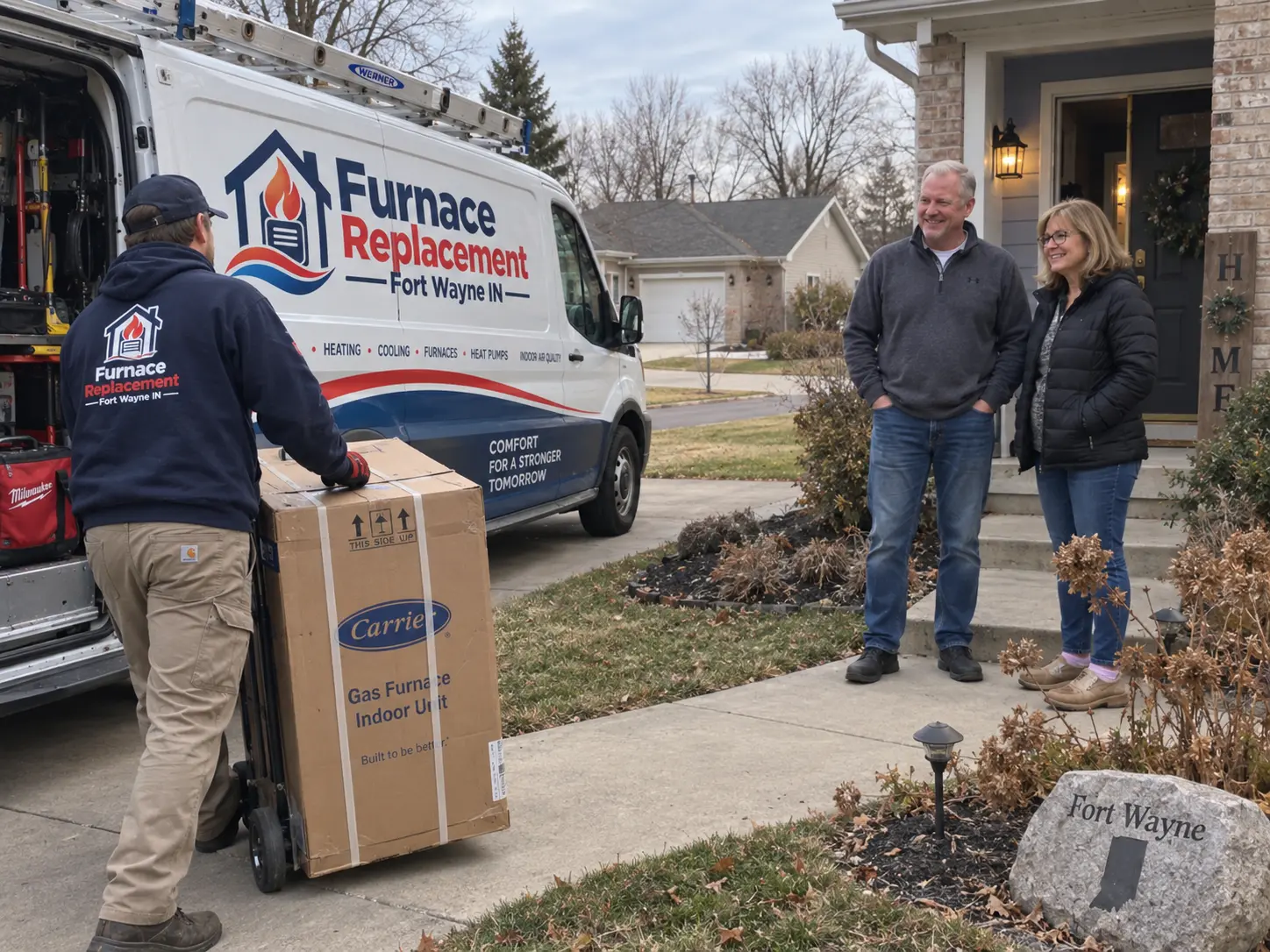
Representative Residential Installation Work
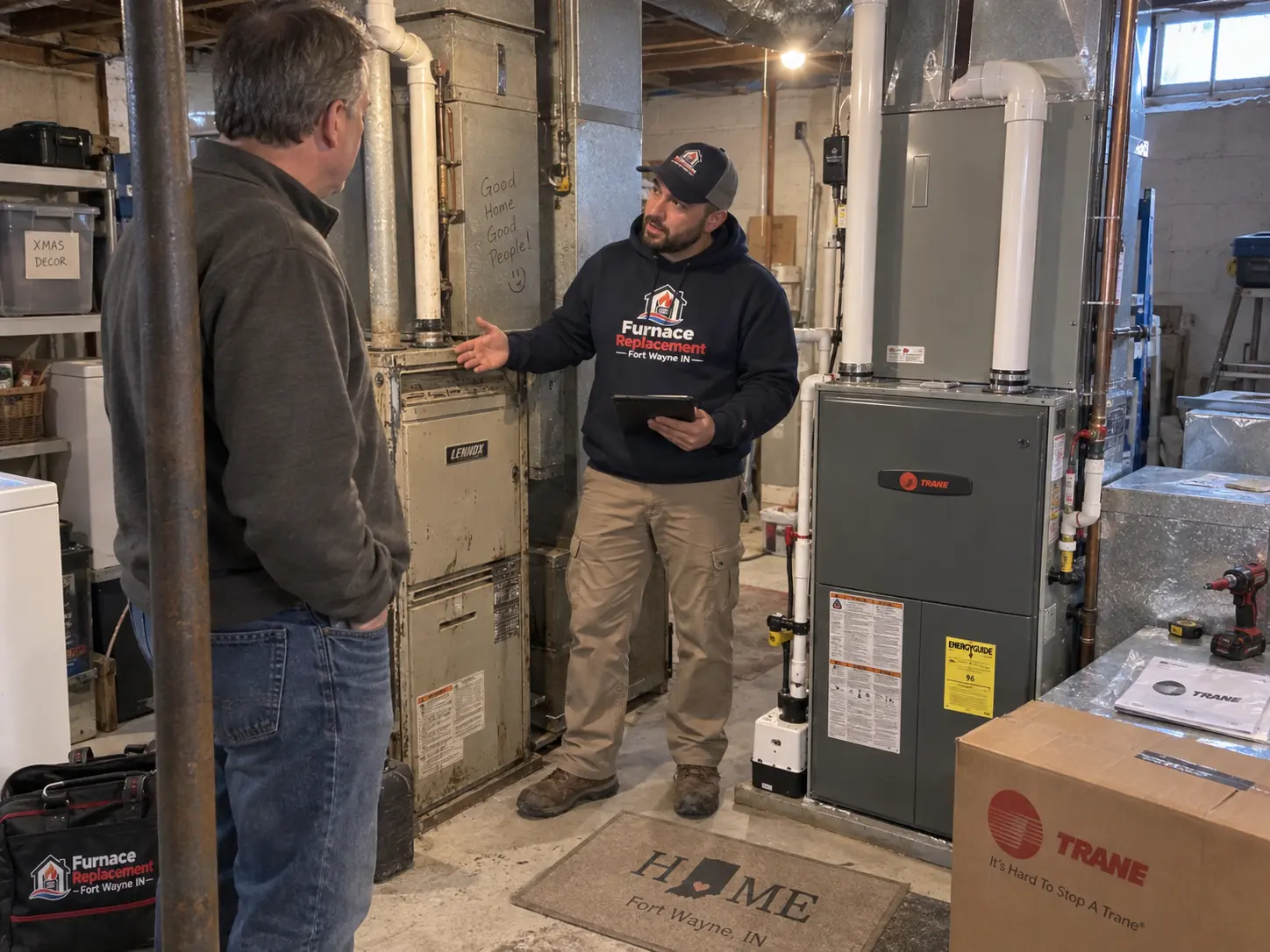
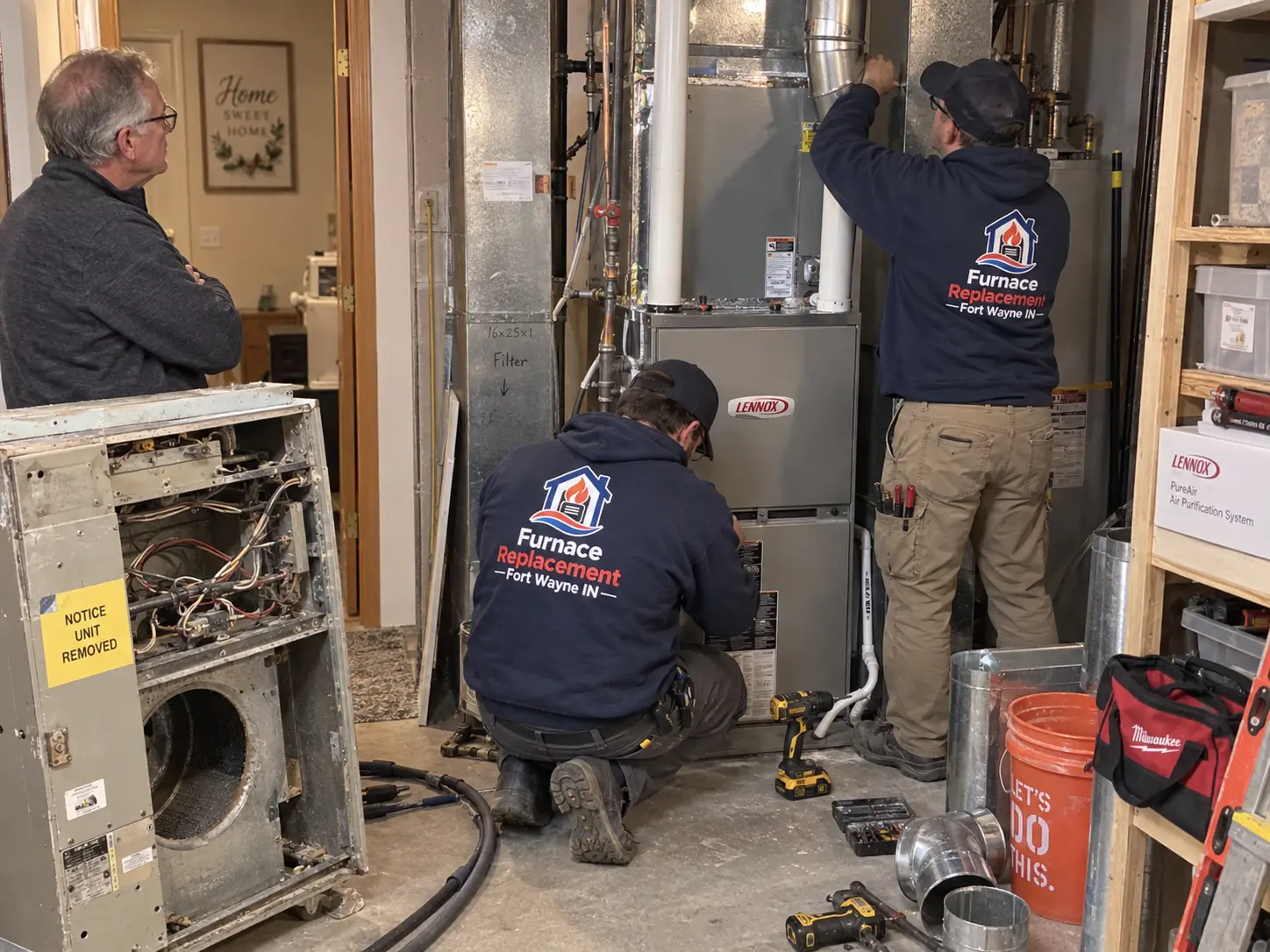
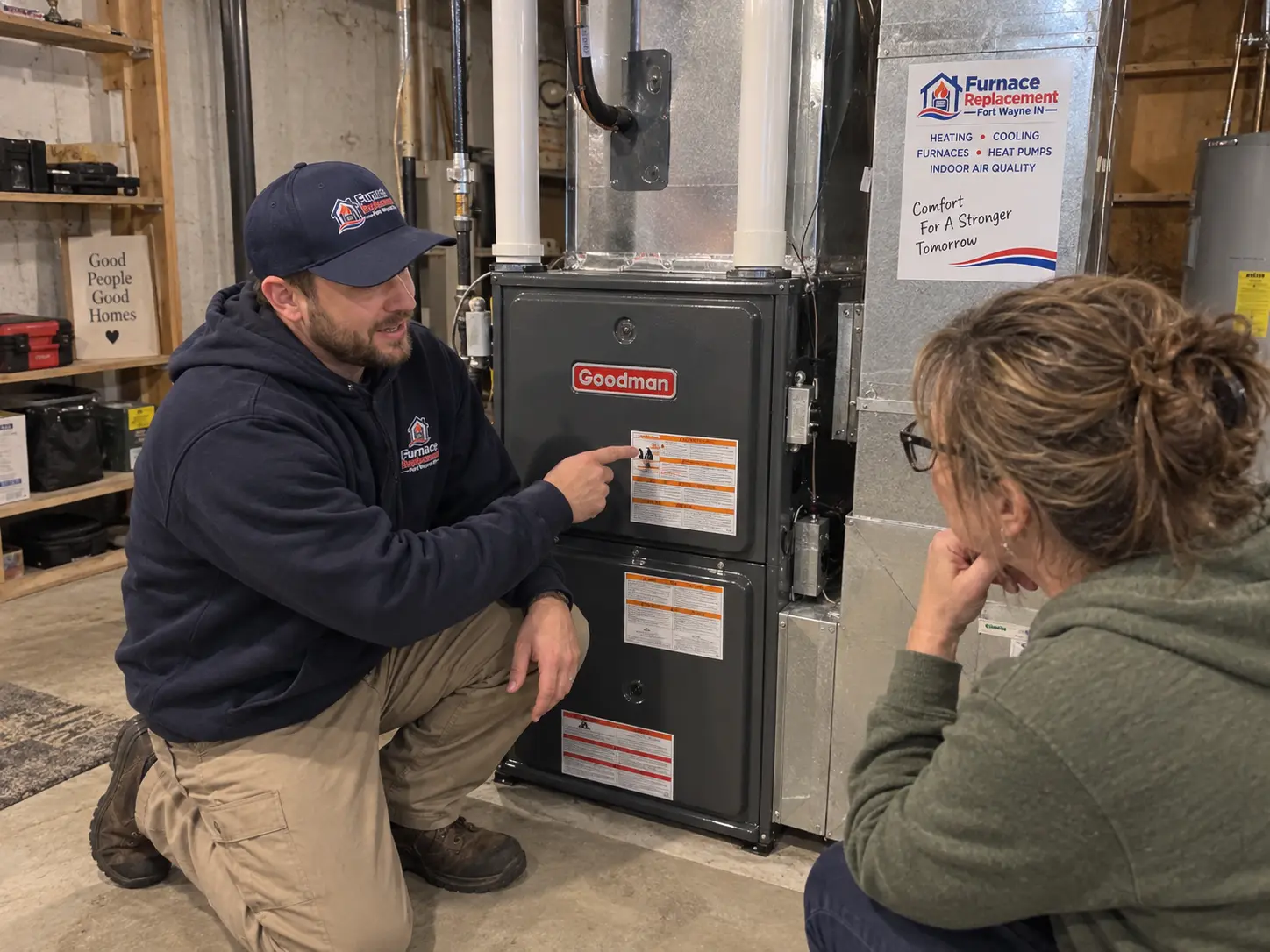
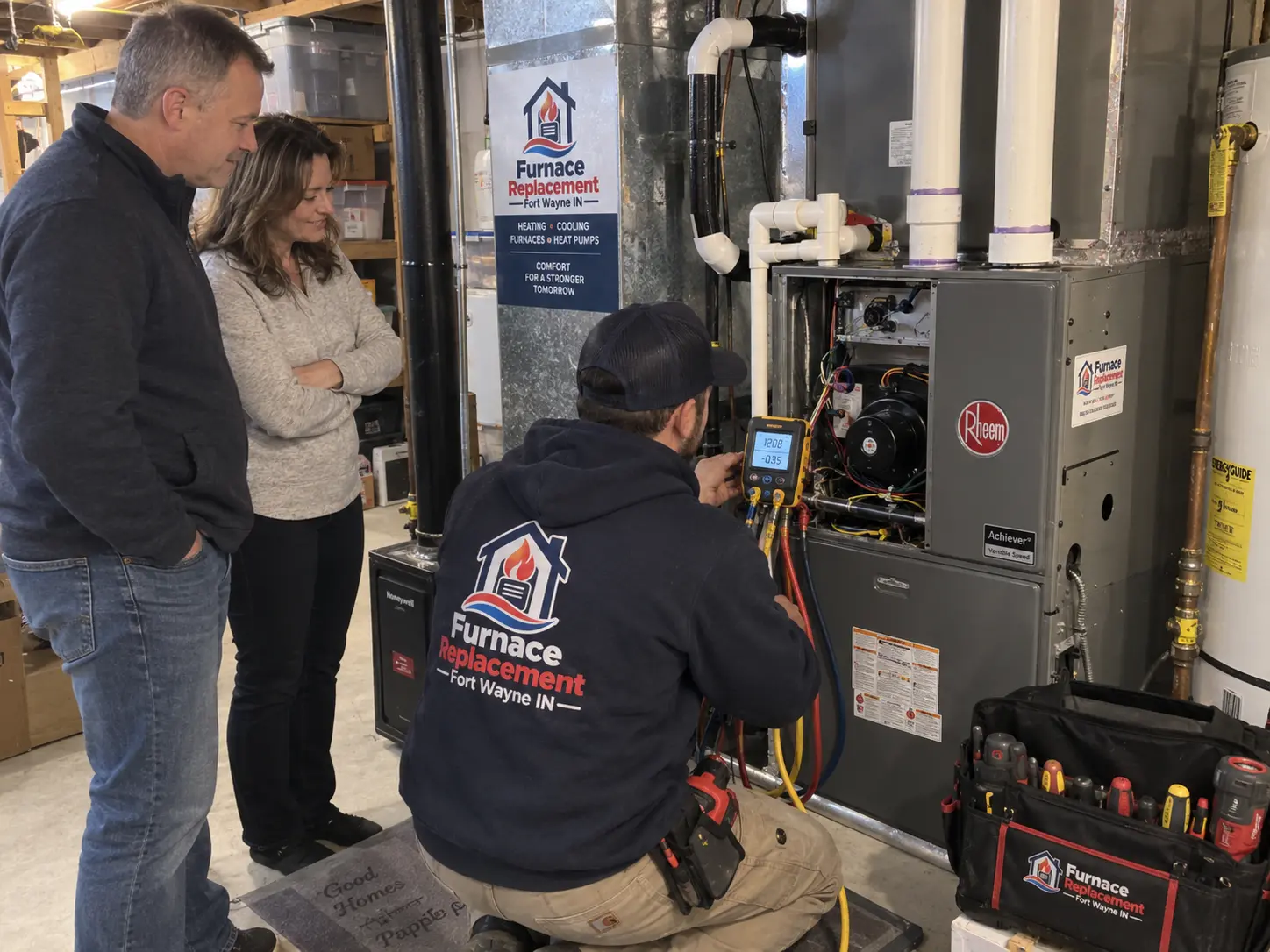
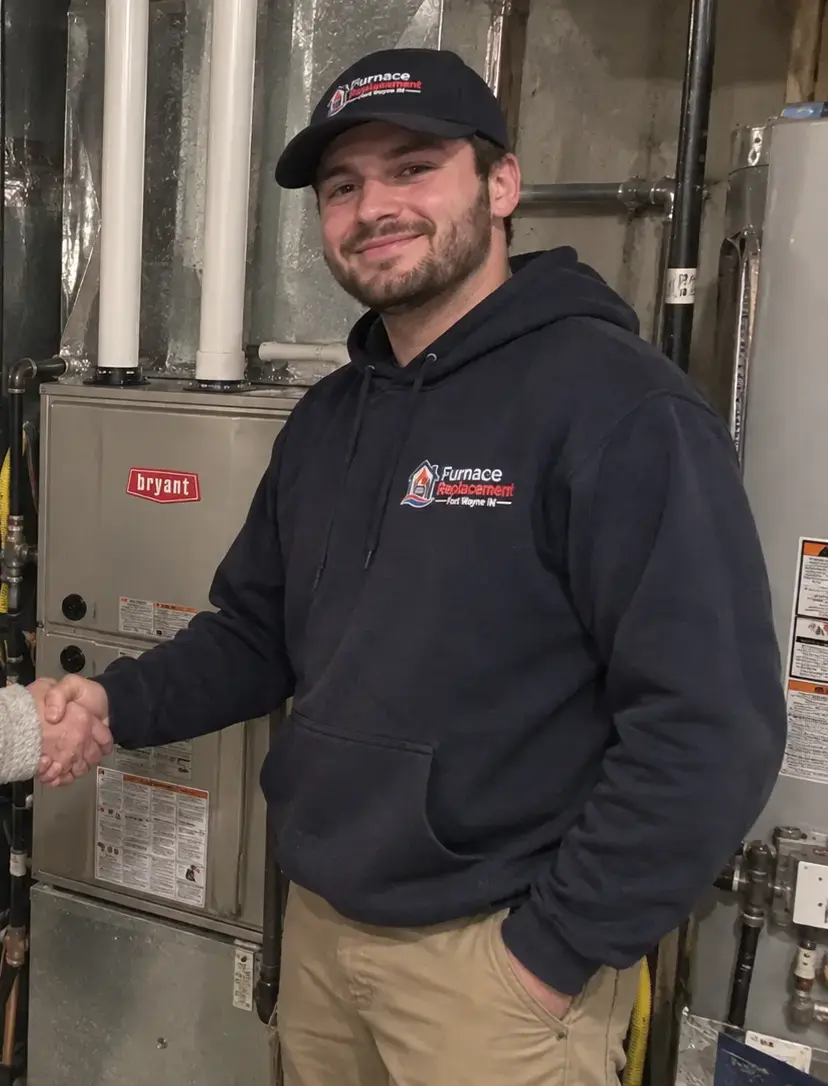
Illustrative images of residential furnace replacement work: delivery, evaluation, removal, installation, startup testing and the homeowner walkthrough.
Residential Service Areas
Fort Wayne is our primary service area, with residential furnace replacement also available in surrounding Northeast Indiana communities. Have your 5-digit ZIP code ready so we can confirm availability for your address.
Primary
Fort Wayne, Indiana
Residential furnace replacement and new furnace installation across Fort Wayne and Allen County — older near-downtown housing, mid-century neighborhoods and newer subdivisions alike.
Why Homeowners Call Us
Residential specialization
Furnace replacement and installation in homes is the whole business.
Straightforward information
Planning ranges, real cost drivers and plain-language explanations.
Free quote
A written scope you can compare against other quotes line by line.
24/7 service availability
Reach us when the heat goes out, not just during office hours.
Home-specific sizing
Load considerations for your house rather than the old nameplate.
Clear equipment options
Efficiency and staging explained in terms of cost and comfort.
Old equipment removal planning
Where the existing furnace goes, addressed up front.
Permit and inspection guidance
What generally applies in Allen County and nearby jurisdictions.
Startup and walkthrough
Testing at completion and a walkthrough before we leave.
Furnace Replacement FAQs
The questions Fort Wayne homeowners ask most. For the organized version by topic, see the full FAQ hub.
How much does furnace replacement cost in Fort Wayne?
How long does furnace replacement take?
How long should a furnace last?
Should I repair or replace a 15-year-old furnace?
Should I replace a 20-year-old furnace?
What AFUE should I choose?
Is a 96% furnace worth it in Fort Wayne?
What size furnace does my home need?
Does furnace replacement require a permit in Fort Wayne?
Can I replace only the furnace and keep my AC?
Should furnace and AC be replaced together?
Can a new furnace use my existing ductwork?
What happens to my old furnace?
What is included in a furnace replacement quote?
What should I compare between furnace quotes?
Can a furnace be replaced during winter?
Do you offer 24/7 service availability?
Do you replace furnaces in manufactured or mobile homes?
Serving Fort Wayne Homeowners
Furnace Replacement Fort Wayne IN
110 E Wayne St, 13th FloorFort Wayne, IN 46802
260-277-3282
This is our Fort Wayne contact and service location for residential furnace replacement across the area. 24/7 service availability.
For service availability, please have your 5-digit ZIP code ready.
Need a Furnace Replacement Quote in Fort Wayne?
24/7 service availability.
For service availability, please have your 5-digit ZIP code ready.